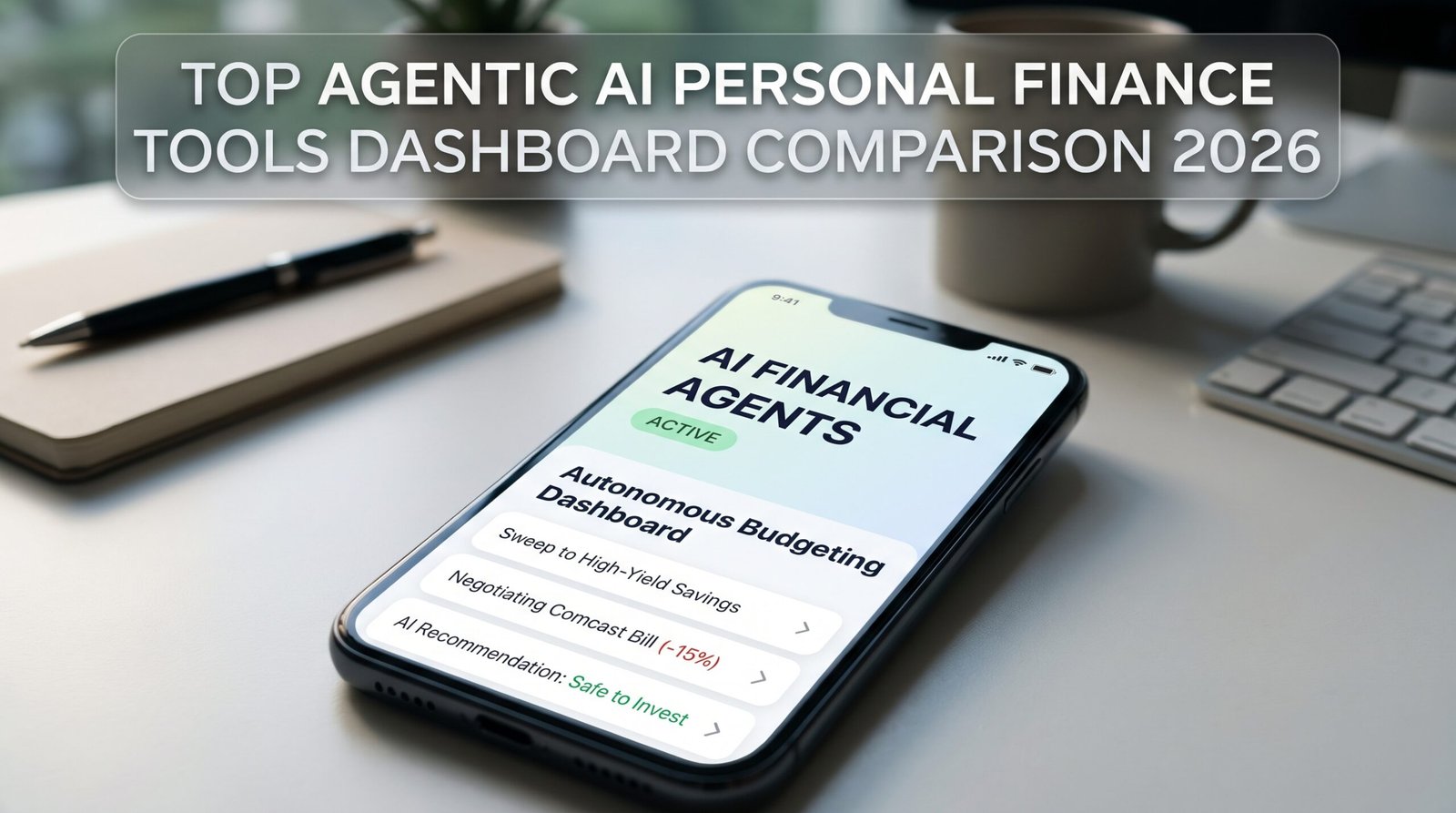

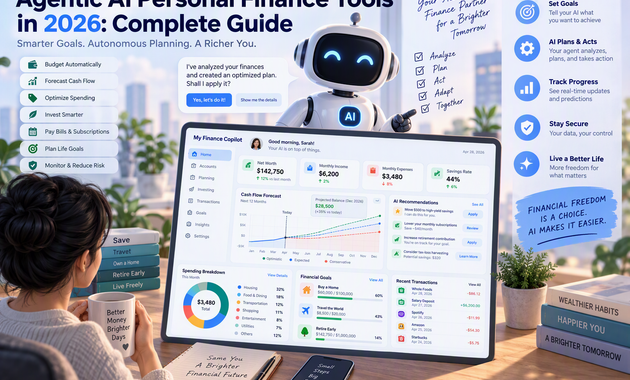
Personal financial management has moved beyond static spreadsheets and manual receipt tracking. While earlier applications only categorized past expenses after the money was already spent, the newest generation of AI personal finance tools in 2026 focuses on proactive, autonomous action—monitoring cash flow in real time, forecasting upcoming bills weeks in advance, and executing portfolio adjustments within user-defined guardrails.
If you have already explored our breakdown of 4 AI for Smarter Financial Planning Decisions and how Mobile Banking in Fintech: Shaping Finance Future 2025 changed everyday transactions, the next major leap in consumer fintech is Agentic AI. Here is how autonomous finance tools differ from standard budgeting apps, which platforms lead the market in 2026, and how to keep your bank accounts secure.
Autonomous AI Agents Replace Reactive Expense Tracking with Proactive Execution
Traditional financial apps wait for your input and display historical charts. By contrast, AI agents in banking and finance act as digital team members that take a financial workflow from initial intent to final resolution. According to industry analysis by Kore.ai, human financial advisors spend only 23% of their working hours in client meetings because administrative tasks consume 60% to 70% of their capacity.
For everyday consumers, Agentic.ai highlights a clear divide between two categories of modern tools:
- AI-Assisted Finance Tools: Applications that categorize transactions automatically, flag unusual recurring charges, and suggest budget adjustments while waiting for your manual approval before taking action.
- AI-Autonomous (Agentic) Tools: Systems that operate within strict guardrails you establish—such as automatically rebalancing investment allocations, harvesting tax losses, negotiating monthly utility bills, or moving surplus idle cash into high-yield savings accounts.
Leading AI Finance and Budgeting Platforms Serve Distinct Financial Goals in 2026
Selecting the right platform depends on whether you want household spending visibility, spreadsheet ownership, or automated wealth management. Based on independent 2026 evaluations from Agentic.ai and Remio.ai, the table below compares top-performing tools across autonomy level, core strength, and pricing structure.
| Platform | Primary Use Case & Core Strength | Autonomy Type | Platform & Pricing Model |
|---|---|---|---|
| Candor | Connects financial accounts with AI agents (like ChatGPT and Claude) to turn natural-language goals into tracked budgets | Guided Agentic Assistant (9/36 Agenticness Score) | Web integration; Paid subscription |
| Lodestar Wealth | Converts bank statements into prioritized net-worth forecasts, debt payoff models, and retirement simulations | Guided Agentic Assistant (8/36 Agenticness Score) | Web platform; Free tier available |
| Rocket Money | Tracks recurring subscriptions, monitors net worth, and negotiates monthly bills on your behalf | Guided Agentic Assistant (8/36 Agenticness Score) | iOS & Android; Freemium (negotiation on Premium) |
| Wealthfront | Automates portfolio rebalancing, tax-loss harvesting, and fractional share investing within risk parameters | Guided Agentic Assistant (7/36 Agenticness Score) | Web & Mobile; Paid (0.25%–0.50% AUM range for AI investment platforms) |
| Monarch Money | Supports multi-user household budgeting with a custom AI categorization rules engine and visual goal projections | Rule-Based AI Tracker | Web & Mobile; Paid subscription |
| YNAB (You Need A Budget) | Combines zero-based budgeting discipline with AI-assisted future-month cash flow projections and debt calculators | Forecast-Driven Tracker (6/36 Agenticness Score) | Web & Mobile; Free trial / Paid |
| Tiller | Streams live bank feeds directly into Google Sheets and Microsoft Excel for custom AI formulas and full data ownership | Spreadsheet-Connected Feed | Google Sheets & Excel; Paid subscription |
| Copilot Money | Runs natural-language spending queries and on-device AI summaries tailored for Apple hardware ecosystems | Reactive AI Tracker (4/36 Agenticness Score) | macOS, iOS, iPad & Web; Paid after free trial |
Read-Only Bank Aggregators and Encryption Protect Sensitive Financial Data
Connecting artificial intelligence to bank accounts naturally raises security concerns. According to Kore.ai, global payments fraud exceeds $190 billion annually, with 94% of banks reporting identity fraud incidents. Before linking any financial app in 2026, verify three mandatory security standards outlined by Agentic.ai and Remio.ai:
- Use Read-Only Aggregation: Choose platforms that connect via established aggregators like Plaid or Yodlee using read-only tokens. Read-only access allows the AI to analyze transaction history without having permission to move funds or alter account settings.
- Verify Security Certifications: Confirm that the provider holds SOC 2 or ISO 27001 compliance, uses bank-level encryption, and publishes transparent data retention policies stating they do not sell aggregated consumer data.
- Maintain Regular Data Exports: Even when using cloud-based trackers, export your transaction history periodically or use spreadsheet-backed tools like Tiller so you never lose your historical financial records if an app changes its pricing tier.
Frequently Asked Questions (FAQ)
What is the difference between an AI budgeting app and an agentic finance tool?
A standard AI budgeting app categorizes past spending and displays visual charts. An agentic finance tool goes a step further by forecasting cash flow, modeling net-worth scenarios, and executing approved actions—such as canceling unused subscriptions or rebalancing investments—within your predefined safety limits.
How much do AI personal finance tools cost in 2026?
According to Agentic.ai, most premium personal finance and budgeting apps cost between $5 and $15 per month, while many offer free basic tiers. Automated AI investment platforms typically charge an annual fee of 0.25% to 0.50% of assets under management (AUM), compared to the 1% to 2% charged by traditional human advisors.
Can AI finance tools completely replace a human financial advisor?
AI tools handle day-to-day budgeting, subscription monitoring, basic asset allocation, and automated tax-loss harvesting effectively at a lower cost (Agentic.ai). However, complex life events—such as multi-jurisdictional tax strategy, estate planning, or business succession—still require certified human financial professionals.
About the Author: Written by the Newslouds Fintech & Digital Economy Editorial Desk at Newslouds.com, covering consumer AI tools, digital banking, and personal wealth technology. Remember to update this byline with your dedicated author profile and LinkedIn URL in WordPress Users settings.
Editorial Disclaimer: This article is for informational and educational purposes only and does not constitute certified financial or investment advice. Always verify security certifications before connecting financial accounts to third-party applications.