


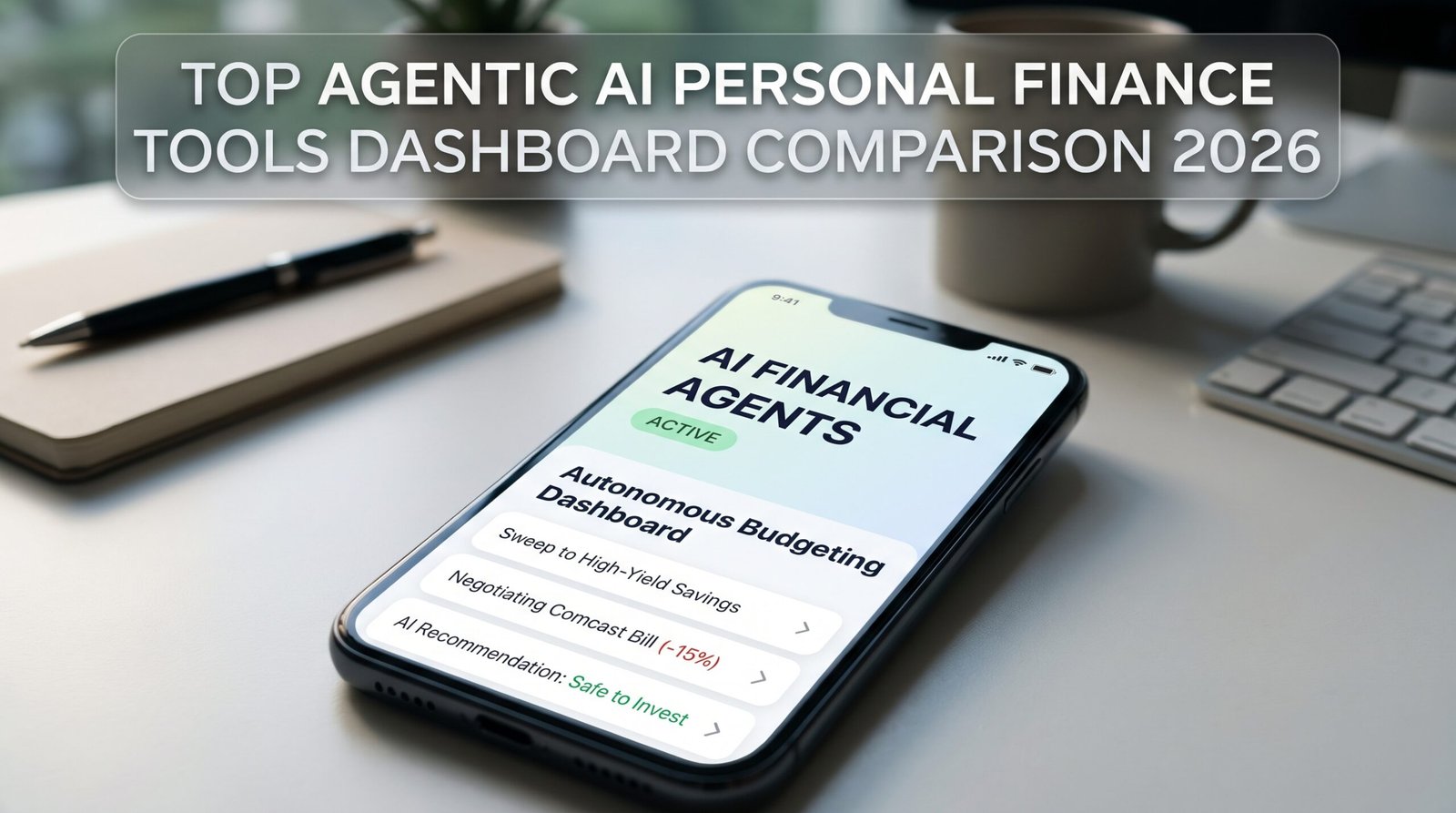
Personal financial management has evolved past retrospective spreadsheets and color-coded pie charts. While earlier budgeting tools merely flagged where your money went after it was already spent, the next generation of fintech relies on agentic AI personal finance tools. These systems move beyond reactive expense tracking to autonomous execution: rebalancing portfolios, cutting recurring subscription waste, negotiating utility bills, and moving surplus cash into high-yield accounts based on preset parameters.
Whether you are searching for autonomous budgeting apps for hands-off wealth building or automated household spending control, here are the 8 best agentic AI personal finance tools tested and ranked for 2026.
What Is Agentic AI in Personal Finance?
Traditional financial tools are reactive—they parse CSV files or sync transactions via read-only APIs and wait for human input. Agentic AI systems are proactive and task-oriented. Powered by Large Action Models (LAMs) and goal-based reasoning loops, an AI agent takes an objective (such as “keep $2,000 liquid buffer and sweep remaining earnings into index funds”) and carries out the necessary multi-step workflows autonomously.
| Feature / Attribute | Traditional Budgeting Apps | Agentic AI Finance Platforms |
|---|---|---|
| Primary Interaction | Manual data entry & review | Natural language goal setting |
| Cash Management | Static expense categorization | Autonomous sweeps & transfers |
| Bill Management | Calendar reminders | Autonomous rate negotiation |
| Portfolio Handling | Read-only balance tracking | Algorithmic rebalancing & tax-loss harvesting |
| Time Investment | 2–4 hours/week | Under 15 minutes/month |
Quick Comparison of the Best AI Finance Tools 2026
| Platform | Best For | Autonomy Level | Starting Price |
|---|---|---|---|
| Candor | Natural-Language Agentic Budgeting | High (Guided execution) | $12/month |
| Lodestar Wealth | Long-Term Net Worth & Debt Modeling | Medium (Actionable roadmaps) | Free tier / $15/mo |
| Rocket Money | Bill Negotiation & Subscriptions | High (Autonomous cancellation) | Freemium ($6–$12/mo) |
| Wealthfront | Automated Wealth & Tax-Loss Harvesting | Autonomous (Portfolio rules) | 0.25% annual AUM |
| Monarch Money | Multi-User Household Cash Flow | Medium (Custom AI rules engine) | $14.99/month |
| YNAB Autopilot | Zero-Based Cash Allocation | Medium (Predictive cash flow) | $14.99/month |
| Cleo | Autonomous Micro-Savings & Spending Guardrails | High (Autonomous sweeps) | Free / $5.99/mo |
| Trim | Overhead & Utility Bill Reduction | High (Autonomous negotiation) | 15% of annual savings |
Detailed Breakdown: The 8 Best Agentic AI Finance Platforms
1. Candor – Best for Natural-Language Financial Agents
Candor connects directly to your institutional accounts and interfaces with advanced LLM agents (including Claude and ChatGPT). Instead of navigating menus, you instruct your agent in plain English: “Analyze my discretionary spending over the last 90 days and set dynamic weekly caps.”
- Key Strengths: Interprets natural language queries, simulates scenario trade-offs, and provides explainable execution paths before taking action.
- Drawback: Requires users to be comfortable prompting conversational interfaces.
- Pricing: 14-day free trial, then $12/month.
2. Lodestar Wealth – Best for Net-Worth Simulation & Action Plans
Lodestar transforms raw banking statements into interactive forecasting models. It is built for individuals balancing student loans, mortgages, and retirement milestones simultaneously.
- Key Strengths: Generates prioritized debt payoff strategies and automatically recalculates tax liabilities when income changes.
- Drawback: Lacks direct micro-investing execution; focuses primarily on planning.
- Pricing: Free baseline access; Premium roadmaps start at $15/month.
3. Rocket Money – Best for Automated Bill Negotiation & Recurring Charges
Rocket Money specializes in eliminating friction from subscription management. Its agent scans recurring charges, identifies hidden price creeps, and initiates cancellation or renegotiation workflows on your behalf.
- Key Strengths: Automated bill negotiation with major telecom and utility providers; one-click subscription cancellation.
- Drawback: The bill negotiation service takes a cut of first-year savings under the premium model.
- Pricing: Freemium; Premium tier ranges from $6 to $12/month (pay what you want).
4. Wealthfront – Best for Autonomous Investing & Tax-Loss Harvesting
Wealthfront remains the standard for algorithmic investing. Its autonomous engines manage asset allocation across globally diversified index funds, monitor daily market volatility, and trigger tax-loss harvesting automatically without manual intervention.
- Key Strengths: Fully hands-off index investing, automated dividend reinvestment, and integrated high-yield cash accounts.
- Drawback: Cannot trade individual single-name stocks within automated index portfolios.
- Pricing: 0.25% annual advisory fee on assets under management (AUM).
5. Monarch Money – Best for Household & Collaborative Budgeting
Built as a modern alternative to legacy tools, Monarch Money employs an intelligent rules engine that learns transaction patterns across multi-user household setups.
- Key Strengths: Real-time multi-account aggregation via Plaid and MX; shared dashboard access for partners and financial planners.
- Drawback: Does not execute trades or move funds directly between external third-party accounts.
- Pricing: $14.99/month or $99.99/year.
6. YNAB (You Need A Budget) – Best for Predictive Zero-Based Budgeting
YNAB pairs its established zero-based budgeting methodology with predictive cash flow models. Its system projects upcoming cash positions based on scheduled obligations and recurring income rhythms.
- Key Strengths: Eliminates the paycheck-to-paycheck cycle; proven methodology for disciplined debt reduction.
- Drawback: Requires an initial learning curve to master zero-based category allocation.
- Pricing: 34-day free trial, then $14.99/month or $109/year.
7. Cleo – Best for Autonomous Micro-Savings & Habit Tracking
Targeted at younger demographics, Cleo uses conversational AI to deliver blunt financial feedback and run autonomous micro-saving routines.
- Key Strengths: “Auto-save” features that calculate spare cash and shift it into interest-bearing reserves; interactive spending accountability.
- Drawback: Humor and conversational tone may not appeal to enterprise-level or conservative wealth builders.
- Pricing: Free core app; Cleo Plus starts at $5.99/month.
8. Trim – Best for Hands-Off Overhead Optimization
Trim operates quietly in the background, identifying recurring bills, subscriptions, and negotiated recurring APRs. It acts as an autonomous advocate, contacting service providers to secure loyalty discounts.
- Key Strengths: Completely passive operation once connected; success-based fee structure for negotiated discounts.
- Drawback: Scope is limited to recurring subscription and utility optimization rather than broad asset management.
- Pricing: Free basic subscription analysis; 15% fee on verified annual savings from successful bill negotiations.
Security First: Protecting Financial Data in the Agentic AI Era
Autonomous financial software requires robust protections before permissions are granted:
- Read-Only API Gateways: Ensure the tool connects through accredited intermediaries like Plaid, MX, or Finicity rather than storing your raw bank login credentials.
- Explicit Execution Limits: Never grant unconditional write/move access. Platforms should require multi-factor authorization (MFA/2FA) for transactions above a designated monetary threshold.
- Data Privacy Guardrails: Verify that the platform does not sell anonymized transaction trends to data brokers or train generalized third-party LLMs on your personal ledger data.
Frequently Asked Questions (FAQ)
What is the difference between an AI budgeting app and an agentic finance tool?
Traditional AI budgeting apps are reactive; they record and display historical expenses. Agentic finance tools are proactive and action-oriented; they can negotiate bills, execute automated transfers, and rebalance investment allocations within user-defined rules.
Can agentic AI personal finance tools move money without permission?
Reputable agentic tools operate strictly within predefined boundaries set by the user. While they can autonomously rebalance assets or sweep excess cash into high-yield savings accounts, major withdrawals or account changes still require explicit biometric or two-factor confirmation.
How much do agentic AI finance platforms cost in 2026?
Consumer budgeting tools generally charge between $6 and $15 per month. Automated wealth and portfolio managers typically operate on an Assets Under Management (AUM) model, averaging between 0.25% and 0.50% annually.
While some may look for the best AI financial advisor to completely manage their portfolios, the consensus is that these tools work best as execution partners within your defined boundaries